Conversion & Funnels
Why users don’t buy: how to find conversion blockers with AI
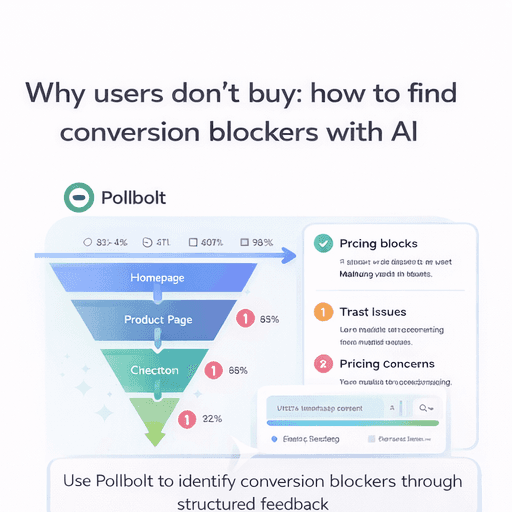
Why Users Aren't Buying (And How to Fix It with User Feedback)
If you have traffic but no sales, you don't have a traffic problem — you have a clarity problem. Most businesses respond to low conversion rates by running more ads, redesigning their homepage, or discounting their prices. They're optimizing blindly, changing variables without understanding the actual reason users aren't buying.
The fastest path to higher conversions isn't a better funnel. It's a better understanding of the people moving through it.
The Real Reason Users Don't Convert
Conversion problems almost always trace back to one of three root causes: users don't understand what you're offering, they don't trust that it will work for them, or they don't believe the price is justified by the value. The challenge is that from the outside, all three look identical — a user who lands on your page and leaves without buying.
Most businesses respond by guessing. They A/B test headlines, swap hero images, and rewrite CTAs — sometimes for months — without ever confirming whether any of those elements were the actual problem. Meanwhile, the real answer is sitting with the users who almost bought and didn't.
The solution is simple: ask them directly.
How to Use User Feedback to Diagnose and Fix Conversion Problems
Step 1: Create a Targeted Feedback Survey
The first step is getting structured feedback from the right people at the right moment — specifically, users who engaged with your product or pricing page but didn't convert. A well-designed exit survey or post-visit follow-up can surface the exact friction point that's costing you sales.
The questions that matter most at this stage are direct and specific:
What stopped you from completing your purchase today?
Was it clear what you would get and how it works?
Did you feel confident that this product would work for you?
Was the price fair given what was being offered?
Was there anything missing that would have helped you decide?
These questions are designed to surface the three core conversion killers — confusion, distrust, and price resistance — without leading respondents toward any particular answer.
Pollbolt can generate these surveys automatically based on your conversion goal. Instead of writing questions from scratch, you enter your objective and Pollbolt produces a complete, optimized survey with logic and follow-ups included — ready to deploy in minutes.
Step 2: Focus on the Signals That Actually Matter
Raw survey responses contain a mix of useful signal and noise. The job at this stage is separating the patterns that point to systemic problems from the one-off complaints that don't generalize.
The three categories of signals most predictive of conversion problems are:
Confusion signals — users who couldn't understand what the product does, who it's for, or what they'd get after purchase. Phrases like "I wasn't sure," "I didn't understand," or "it wasn't clear" are diagnostic. Confusion is a messaging problem, and it's fixable.
Trust signals — users who understood the offer but didn't believe it would work for them specifically. This shows up as skepticism about results, questions about credibility, or concerns about risk. Trust issues require social proof, guarantees, or clearer specificity about who the product is designed for.
Pricing signals — users who wanted the product but couldn't reconcile the price with the perceived value. This is rarely about the number itself. It's almost always about how value is communicated relative to cost. Users who say "it's too expensive" are usually saying "I don't yet understand why it's worth that."
Pollbolt's analysis engine clusters responses into these categories automatically, so you're not reading through hundreds of free-text answers manually. You get a structured breakdown of which signals are most common, and how severe each pattern is across your respondent pool.
Step 3: Turn Feedback into Specific Conversion Actions
Insight without action is just data. The final step is mapping each signal category to a concrete change you can test on your site or in your funnel.
If confusion is the dominant signal, the fix lives in your messaging. Rewrite your headline to state the outcome you deliver, not the feature you offer. Simplify your above-the-fold copy so a first-time visitor understands what you do in under five seconds. Add a "how it works" section that removes ambiguity from the buying process.
If trust is the dominant signal, the fix lives in your credibility infrastructure. Add case studies that reflect your target user's specific situation. Make your guarantee more prominent and more specific. Include logos, reviews, or third-party validation closer to your primary CTA. Address the most common objection directly on the page rather than leaving users to resolve it on their own.
If pricing is the dominant signal, the fix lives in your value communication. Don't discount first — reframe. Make the cost of not buying visible. Break down what's included in concrete, tangible terms. Add a comparison that contextualizes the price against alternatives or the cost of the problem you solve.
Pollbolt generates specific recommendations alongside its insight summaries, so your team receives not just a diagnosis but a prioritized list of actions tied directly to what users told you.
How Often Should You Run Conversion Feedback Surveys?
User feedback on conversion friction isn't a one-time fix — it's an ongoing diagnostic. Run a conversion-focused survey whenever you launch a new pricing page, after a significant traffic spike that didn't produce expected sales, when you change your offer or positioning, or on a quarterly basis as a standing health check.
The teams with the highest conversion rates aren't necessarily the ones with the best designers or copywriters. They're the ones who talk to their users most consistently and act on what they hear fastest.
Frequently Asked Questions
Why are users visiting my site but not buying?
The most common reasons users don't convert are unclear value propositions, insufficient trust signals, and price-to-value misalignment. The only reliable way to diagnose which problem applies to your specific audience is to ask them directly through a targeted feedback survey.
How do I find out why users aren't converting?
Deploy an exit survey or post-visit follow-up targeting users who engaged with your pricing or product page but didn't purchase. Ask open-ended questions about what stopped them, whether the offer was clear, and whether they trusted the product. Tools like Pollbolt automate survey creation and response analysis so you can identify the root cause quickly.
What questions should I ask users who didn't buy?
The most diagnostic questions are: What stopped you from completing your purchase? Was it clear what you would get? Did you feel confident this product would work for you? Was the price fair given what was offered? These four questions consistently surface the confusion, trust, and pricing signals that explain most conversion failures.
How do I fix a low conversion rate?
Start with feedback before changing anything. Once you've identified whether the primary issue is messaging clarity, trust, or perceived value, make targeted changes to your copy, social proof, or value framing. Test one change at a time so you can measure what's actually working.
Is user feedback better than A/B testing for conversion optimization?
They work best together. A/B testing tells you which version performs better. User feedback tells you why. Starting with feedback reduces the number of tests you need to run — because you're testing changes informed by real user reasoning rather than designer intuition.
Conclusion: Understanding Your Users Is the Fastest Way to Increase Conversions
More traffic won't fix a clarity problem. More ads won't fix a trust problem. More discounts won't fix a value communication problem. The only thing that fixes conversion issues is understanding exactly what's stopping your specific users from buying — and that understanding only comes from asking them directly.
Pollbolt makes that process fast, structured, and actionable. From generating the right survey questions to analyzing responses and surfacing prioritized recommendations, it compresses the gap between "we have a conversion problem" and "here's exactly what to do about it."
The best-converting products in 2026 aren't the most cleverly designed. They're the most clearly understood — by the teams building them, and by the users buying them.
Join the AI Revolution
Ready to turn responses into revenue?
Understand your audience. Act with confidence. Grow faster.
Join the AI Revolution
Ready to turn responses into revenue?
Understand your audience. Act with confidence. Grow faster.
Join the AI Revolution
Ready to turn responses into revenue?
Understand your audience. Act with confidence. Grow faster.
Join the AI Revolution
Ready to turn responses into revenue?
Understand your audience. Act with confidence. Grow faster.