Customer Research
Best way to validate a startup idea using AI (2026 guide)
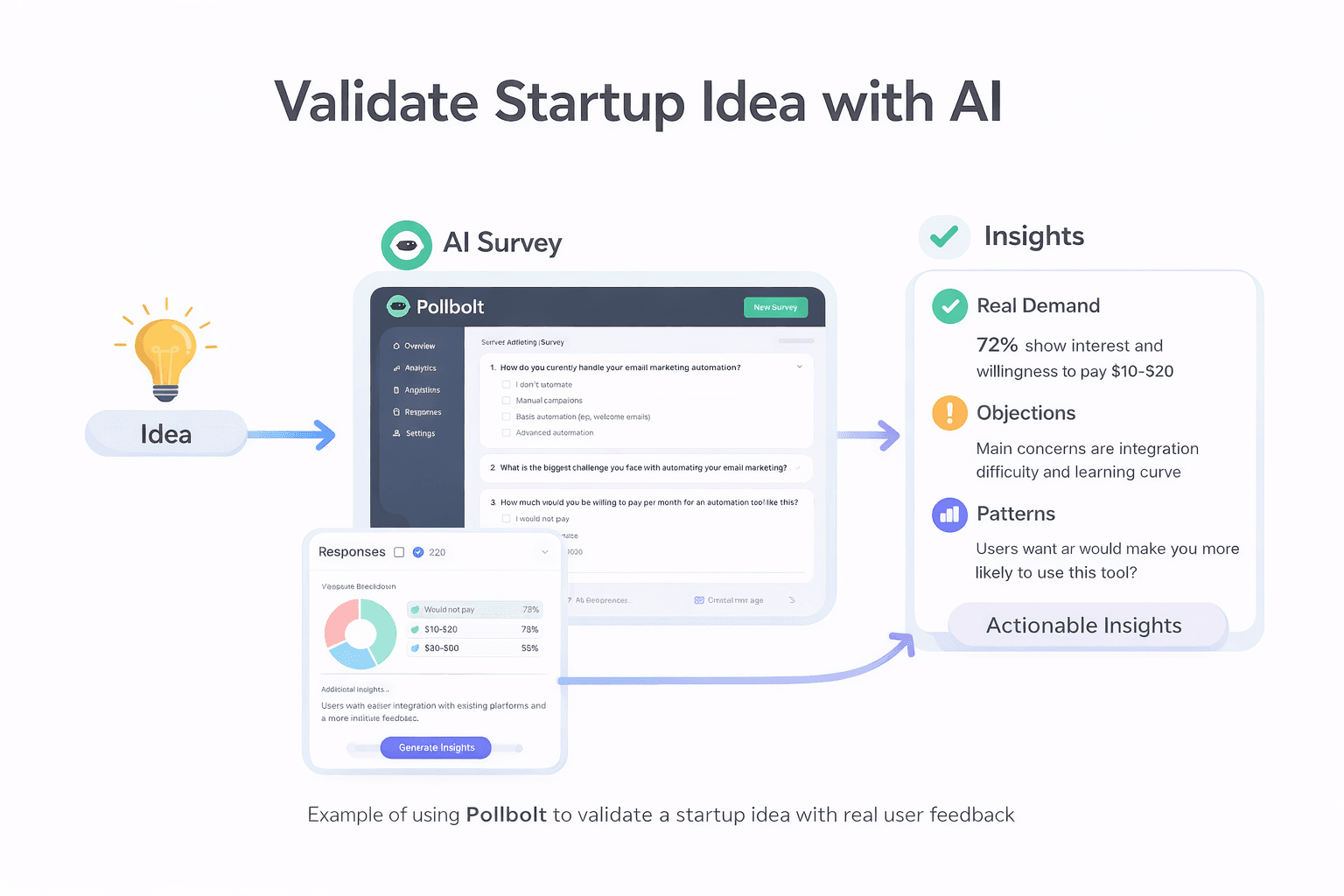
How to Validate a Startup Idea with AI and User Feedback (2026 Guide)
Most startups fail because they build something nobody wants. Not because the founders weren't talented, weren't working hard, or didn't have enough funding — but because they skipped the one step that would have told them whether their idea had a real market before they spent months building it.
Idea validation used to be slow, expensive, and accessible only to teams with dedicated researchers. In 2026, AI has changed that entirely. Any founder can now run a structured, data-driven validation process in days — not months — using AI-generated surveys and automated insight analysis. Here's exactly how to do it.
Why Most Startup Ideas Fail Validation (And Why That's a Good Thing)
Discovering that your idea needs to change is not failure. It's the entire point of validation. The founders who struggle are the ones who skip validation entirely, build for six months based on assumptions, and only discover the market misalignment after launch — when the cost of pivoting is enormous.
Real validation isn't asking friends whether your idea sounds good. It isn't collecting "would you use this?" responses from people who want to be encouraging. It's structured testing of the specific assumptions your business depends on — willingness to pay, severity of the problem, and whether your proposed solution is actually better than what people are already doing.
AI makes that structured testing fast and accessible for the first time.
How to Validate a Startup Idea with AI: Step by Step
Step 1: Define Your Core Hypothesis
Before you write a single survey question, you need to articulate the assumptions your idea depends on. Every startup idea contains a set of beliefs about the world that may or may not be true. Validation is the process of testing those beliefs against reality.
Start by answering three questions in writing:
What problem are you solving? Be specific. "People are busy" is not a problem. "Freelance designers lose an average of six hours per week chasing late invoice payments" is a problem. The more precisely you can define the pain, the more useful your validation data will be.
Who specifically has this problem? Resist the instinct to say "everyone." Define your target user by role, behavior, situation, or context. The narrower your hypothesis, the more actionable your feedback.
What does your solution do that existing alternatives don't? If users can already solve this problem adequately with existing tools, your real hypothesis is about differentiation — not just demand. Name the alternatives and articulate why your approach is meaningfully better.
Write these answers down before building your survey. They become the brief that guides every question you ask.
Step 2: Generate a Validation Survey with AI
With your hypothesis defined, use Pollbolt to generate your validation survey. Enter your research objective — your target user, the problem you're solving, and what you need to learn — and Pollbolt's AI generates a complete, structured survey optimized for startup validation.
A well-designed validation survey tests three categories of assumptions:
Willingness to pay — Do users value this solution enough to exchange money for it? This is the single most important signal for early-stage founders. Enthusiasm without willingness to pay is not a market. Pollbolt generates pricing questions that reveal not just whether users would pay, but what they'd pay, what pricing model they'd prefer, and what would make them feel the price was justified.
Pain point severity — How acute is the problem today? Users who experience a problem occasionally and work around it easily are not the same as users for whom the problem is a daily, costly frustration. Validation surveys need to distinguish between these groups, because only the latter represents a compelling initial market.
Current alternatives — What are users doing right now to solve this problem? The answer to this question tells you more about your competitive landscape than any market research report. If users say they're doing nothing, that often signals the problem isn't severe enough to act on. If they're using expensive, clunky workarounds, that's strong evidence of unmet demand.
Unlike building a survey from scratch, Pollbolt generates question logic, follow-up prompts, and skip patterns automatically — so you're not spending hours on survey design before you've even tested your idea.
Step 3: Collect Real Feedback from Your Target Audience
A validation survey is only as good as the respondents who complete it. Feedback from friends, family, and colleagues is almost always misleading — they want to support you, and that desire colors their honesty. You need responses from people who have no social stake in your success.
The most effective channels for reaching genuine target users at the validation stage are:
Online communities — Reddit communities, Slack groups, Discord servers, and LinkedIn groups organized around the problem you're solving. These audiences are self-selected around the exact pain point you're testing, and members are typically willing to share detailed opinions with founders who approach them respectfully.
Early access lists — If you've been building in public or have a landing page, the people who signed up for early access represent high-signal respondents. They've already demonstrated interest; validation surveys help you understand the depth and nature of that interest.
Relevant professional forums and networks — For B2B ideas especially, industry-specific communities and professional associations are valuable distribution channels. A validation survey shared in the right LinkedIn group or Slack community can reach dozens of qualified respondents within 48 hours.
Targeted outreach — Direct messages to people whose LinkedIn profiles, social posts, or community activity suggests they experience the problem you're solving. A personalized, brief message explaining what you're building and asking for five minutes of feedback converts surprisingly well when it's genuinely targeted.
Aim for a minimum of 30 to 50 completed responses before drawing conclusions. Below that threshold, patterns may not be statistically meaningful. Above 100 responses, you'll typically find that additional data confirms rather than changes your initial findings.
Step 4: Analyze Insights to Find Real Demand
Collecting responses is the easy part. The most important step in the entire validation process is understanding what the data actually means — and that requires more than reading through a spreadsheet.
Pollbolt's analysis engine processes your responses automatically, clustering open-ended answers by theme, detecting sentiment patterns, and surfacing the signals most relevant to your validation hypothesis. Instead of spending days manually coding qualitative responses, you get a structured insight summary that distinguishes real demand from polite interest.
The four most important signals to look for in your validation data are:
Unprompted urgency — Respondents who describe the problem in vivid, emotional terms without being asked. When users volunteer language like "this costs me hours every week" or "I've tried everything and nothing works," that's genuine pain, not survey-response politeness.
Specific willingness to pay — Not just "yes I'd pay for this" but responses that name a price range or compare the value to something they already spend money on. Vague enthusiasm is cheap. Specific financial commitment signals real demand.
Consistent objections — Patterns in what users say would stop them from buying. These are not reasons to abandon the idea — they're the exact problems your product needs to solve before launch. Objections that appear in more than 20% of responses should be treated as product requirements.
Alternative frustration — Respondents who describe current solutions as inadequate, overpriced, or poorly suited to their needs. Frustration with alternatives is one of the strongest predictors of switching behavior.
Pollbolt identifies and prioritizes these signals automatically, so your team receives a clear picture of where genuine demand exists and where your hypothesis needs to be refined.
What to Do After Validation: Three Outcomes
Validation rarely produces a simple yes or no. Most founders encounter one of three outcomes:
Strong validation — Clear willingness to pay, high pain severity, and strong frustration with alternatives. This is the green light to build. Move to defining your MVP around the specific use cases that generated the strongest signal.
Partial validation — Demand exists, but for a different version of your idea than you originally conceived. Maybe the target user is slightly different, the pricing model needs to change, or the problem is more specific than you assumed. This is extremely common and valuable — it means you've found a real market that needs a refined approach.
Invalidation — The problem isn't severe enough, users are satisfied with existing alternatives, or willingness to pay is absent. This is the best possible outcome at the idea stage. Discovering a flawed hypothesis before building saves months of work and significant capital. Use what you learned to sharpen your next hypothesis and run the process again.
Frequently Asked Questions
What is the fastest way to validate a startup idea in 2026?
The fastest approach combines a clearly defined hypothesis with an AI-generated validation survey distributed to your target audience online. Using Pollbolt, founders can design a complete validation survey, collect responses from real users, and receive an automated insight analysis in days rather than weeks.
How do you validate a startup idea without spending money?
Distribute your validation survey through free channels — Reddit communities, LinkedIn groups, Discord servers, and direct outreach to target users. AI tools like Pollbolt dramatically reduce the time and cost of survey design and analysis, making rigorous validation accessible without a research budget.
How many responses do you need to validate a startup idea?
A minimum of 30 to 50 completed responses from genuine target users is sufficient to identify meaningful patterns. For higher-confidence validation — particularly before making significant investment decisions — aim for 100 or more responses. Quality of respondents matters more than quantity; 40 responses from verified target users are worth more than 200 from a general audience.
What questions should a startup validation survey include?
An effective validation survey should test willingness to pay, pain point severity, frequency of the problem, current alternatives being used, and the specific outcomes users are trying to achieve. Pollbolt generates these question sets automatically based on your research objective.
What is the difference between validation and market research?
Market research describes an existing market. Validation tests whether your specific idea has a place in it. Validation is hypothesis-driven — you're testing specific assumptions about your user, their problem, and their willingness to pay — rather than gathering general industry data.
How do I know if my startup idea is validated?
Your idea is validated when a meaningful percentage of your target respondents describe the problem in urgent terms, express specific willingness to pay at a price point that supports your business model, and indicate that existing alternatives are inadequate. Pollbolt's insight analysis surfaces these signals automatically so you can assess validation strength with confidence.
Conclusion: Validation Is Not About Opinions — It's About Data
The founders who build successful companies aren't necessarily the ones with the best ideas. They're the ones who test their ideas against reality before committing to them — and who move fast enough to iterate when the data points somewhere unexpected.
AI has removed the last remaining excuse for skipping validation. With tools like Pollbolt, any founder can run a structured, data-driven validation process in days, without a research team or a significant budget. The survey writes itself. The analysis happens automatically. What's left is the decision — and that decision is far easier to make when it's grounded in what real users actually told you.
Build what people want. Validate first.
Join the AI Revolution
Ready to turn responses into revenue?
Understand your audience. Act with confidence. Grow faster.
Join the AI Revolution
Ready to turn responses into revenue?
Understand your audience. Act with confidence. Grow faster.
Join the AI Revolution
Ready to turn responses into revenue?
Understand your audience. Act with confidence. Grow faster.
Join the AI Revolution
Ready to turn responses into revenue?
Understand your audience. Act with confidence. Grow faster.